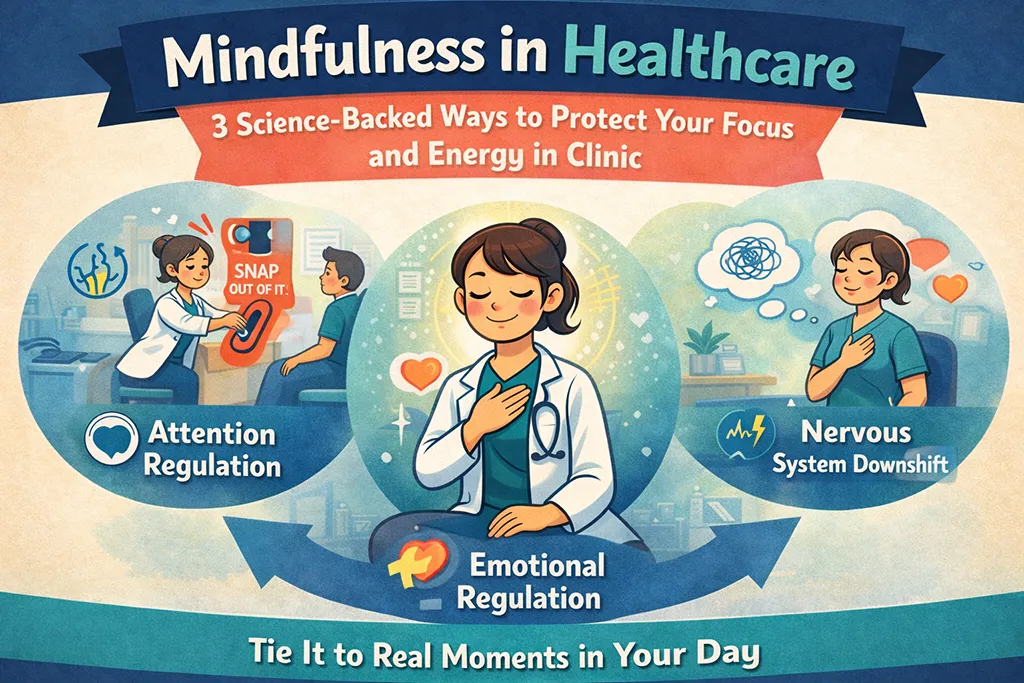
Mindfulness in Healthcare: 3 Science-Backed Ways to Protect Your Focus and Energy in Clinic
If you’re a healthcare professional working one-to-one with clients all day, you already know this: your attention and your nervous system are part of the treatment room. That’s why mindfulness in healthcare matters.
Mindfulness doesn’t need to mean meditation, sitting in lotus position, or adding yet another task to your day. In a clinical setting, it can be as practical as noticing when your mind has sprinted ahead to the next patient, and gently bringing it back to the person in front of you.
Below are three simple, science-based mechanisms that explain why mindfulness helps, especially for solo practitioners who carry the clinical work and the business work in the same week (and sometimes in the same evening).
Why mindfulness isn’t “fluffy” when you work in healthcare
Mindfulness often gets dismissed as soft or vague. Yet the research and real-world outcomes keep pointing in the same direction: it’s a low-cost, reliable way to support stress regulation, attention, and emotional steadiness for both patients and healthcare workers.
It’s not about “being calm all the time.” It’s about building the ability to come back to yourself, even when the day is full.
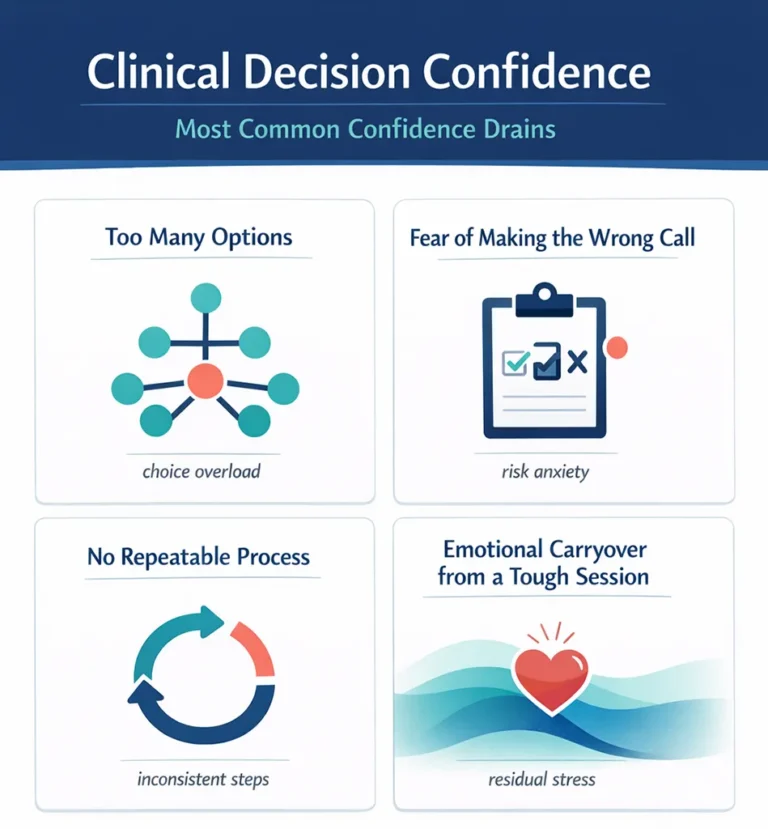
Healthcare work quietly demands a lot from your brain. You’re tracking symptoms, noticing changes, adjusting plans, and staying present with big emotions. Then you finish clinic and (because you’re self-employed) you still have emails, notes, stock, marketing, and admin waiting in the wings. If you want the business side to feel less foggy, it helps to keep it simple and clear, for example by using a simple business plan for solo health practices that reduces decision fatigue.
Here’s what tends to make mindfulness useful for clinicians, rather than just “nice”:
I was taught mindfulness during my acupuncture training, as a tool for me and for my clients. That framing still holds up. To offer it with integrity, it helps to practise it yourself first, even in tiny doses.
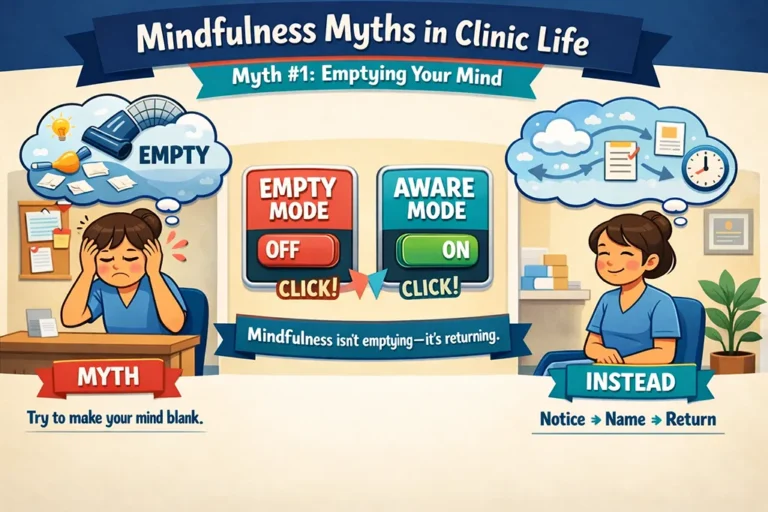
Mindfulness isn’t about emptying your mind. It’s about noticing what your mind is doing, then regaining choice.
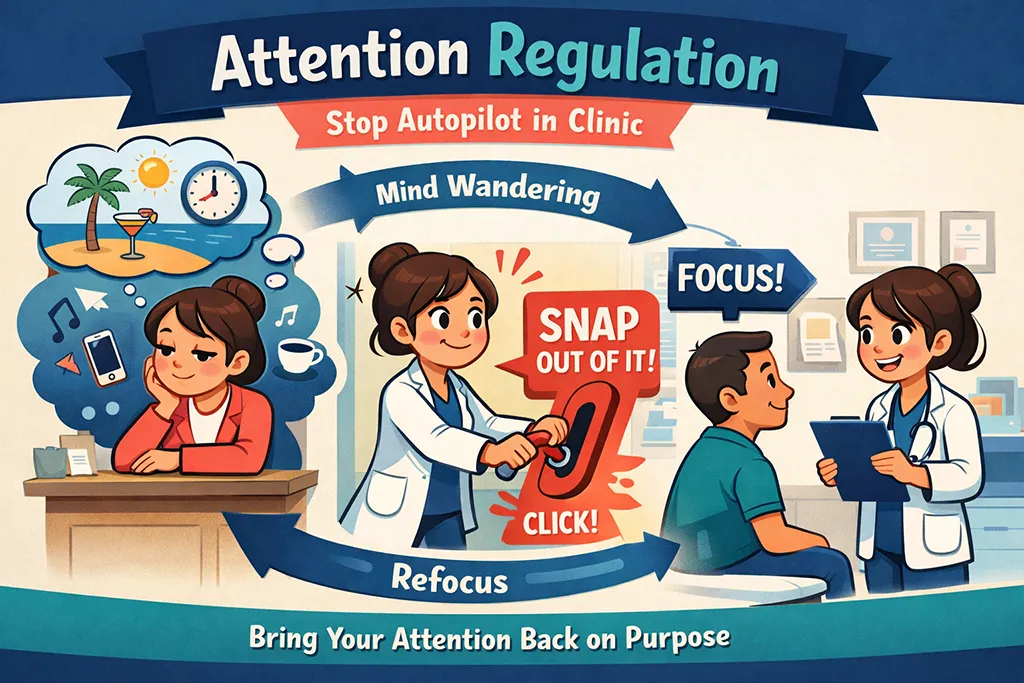
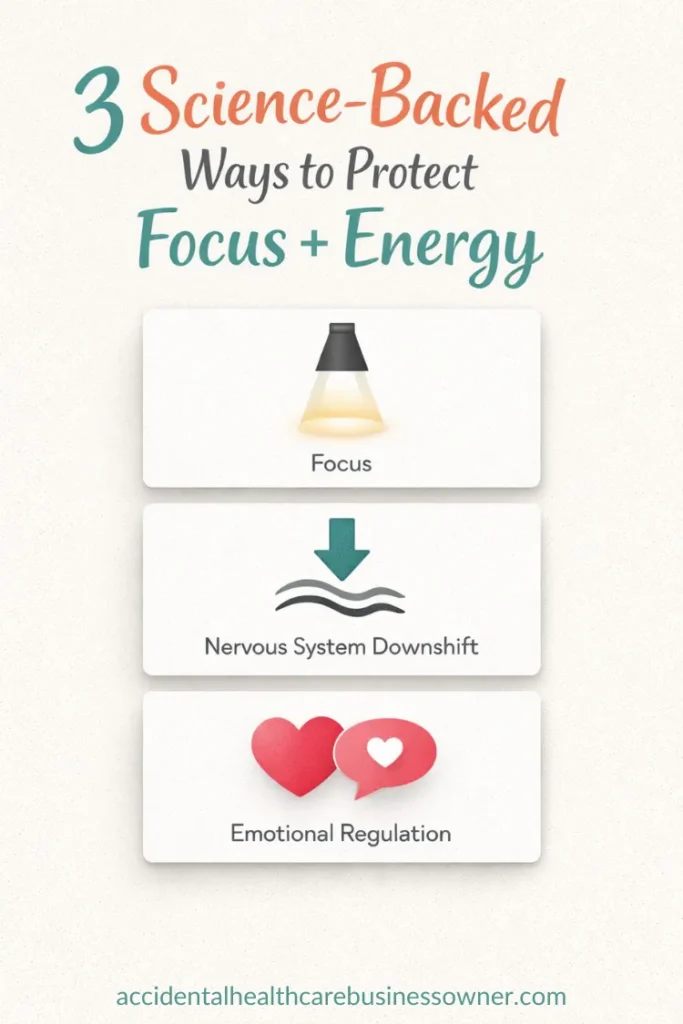
Mechanism 1: Attention regulation (stopping autopilot in clinic)
Attention regulation sounds technical, but it’s very down to earth. It means training your mind to notice when it has wandered, then bringing it back on purpose.
What happens to attention under pressure
Under stress, the brain loves a habit loop. Attention narrows, it scans for threat, and it defaults to “What if?” thinking.
In clinic, that can look like:
You’re taking a history, but part of your mind is already rewriting the next client’s plan. You hear the words, yet you miss the meaning. Or you feel hurried, so you rush your notes and later can’t remember why you made a decision. Even if you’re highly skilled, a busy day can push you into a kind of functional autopilot.
The tricky part is that autopilot can feel productive. You’re moving quickly, you’re getting things done. However, it often comes with more small errors, less listening, and a sense that you never properly “finish” work, because once clinic closes, business tasks begin.
Attention also gets sticky after a difficult session. You might replay a conversation while you wash your hands, reset the room, and greet the next person. The body is present, but the mind is still elsewhere.
What mindfulness changes (in plain English)
Mindfulness trains the ability to notice where your attention is, and move it back deliberately. You’re not trying to stop thoughts. You’re interrupting autopilot.
A useful image is a flashlight. Your attention points somewhere, and your brain follows the beam. If you don’t aim the flashlight, it will point itself, usually toward worries, future planning, or self-critique. Any of these sound familiar?
When you practise mindfulness, even briefly, you’re strengthening the skill of aiming the flashlight where you want it, and bringing it back when it wanders. Over time, that becomes more natural. You recover faster after an interruption. You come back faster after a difficult comment. You spend less time mentally “splitting” across tasks.
Why attention regulation helps patient care
Attention is the gateway to almost everything you do in a session: clinical reasoning, empathy, communication, and decisions.
When attention steadies, you may notice:
You listen more cleanly, without rushing to the next step. You ask better questions. You pick up small cues you would have missed. You also get less dragged into stress-driven thinking, the kind that makes everything feel urgent.
A few practical knock-on effects clinicians often value:
A 30-second practice: Notice, name, return
This is as simple as it sounds, and it works well between clients.
- Notice your mind has wandered.
- Name what it’s doing (planning, worrying, replaying, judging).
- Return to the task at hand, or to a body cue (feet on the floor, hands, breath).
That’s it. No drama. No self-scolding. Each return is the rep that strengthens the skill.
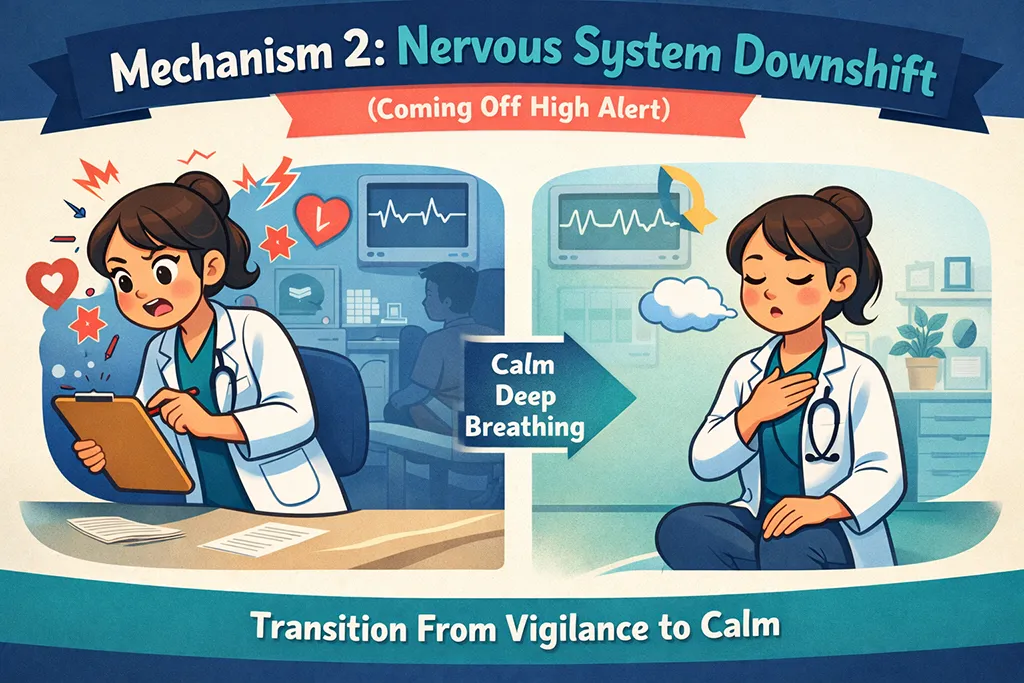
Mechanism 2: Nervous system downshift (coming off high alert)
Healthcare work can keep the body in a semi-activated stress state. You’re concentrating, watching for changes, and staying alert to what the client is doing and feeling. It’s caring work, but it’s still vigilance.
How “high alert” shows up in a normal clinic day
Many practitioners don’t notice the stress response until it’s loud. Yet the earlier signs are often physical:
Shallow breathing. Tight shoulders. Jaw tension. A sense of being keyed up, even during a calm appointment. You might feel fine during clinic, then feel wrung out afterwards.
Over time, that “baseline activation” can start to feel normal. Sleep can get lighter. Patience gets shorter. Uncertainty becomes harder to tolerate (and healthcare is full of uncertainty, even in simple cases). The mind can feel busy even when the room is quiet.
As you’re also running a business, recovery time often gets squeezed. Admin, content, accounts, and planning don’t look stressful on paper, but they still keep the nervous system switched on.
I went through a period, shortly after setting up, where I was occasionally waking during the night. Conversations with clients were replaying on a loop in my head. For me, it was part of settling into my new role but mindfulness helped to stop the loop, without self-judgement.
What mindfulness does physiologically
Mindfulness practices that incorporate mindful breathing and body awareness help you notice stress cues earlier, then shift state.
The goal is not to remove stress from healthcare work. That’s not realistic. The goal is to improve recovery, so you can downshift more easily and more often.
Breath and body practices can act like a “reset button” because they give your nervous system a clear signal of safety. You’re telling the body, “We can soften now,” even if the day is still busy.
If you want a research-grounded overview of how mindfulness-based approaches, including meditation, are used in health settings, the U.S. National Center for Complementary and Integrative Health has a helpful starting point.
Why your regulation matters to patients
Clients pick up your signals, even if neither of you names it. When you’re regulated, you tend to speak more steadily, pause more naturally, and explain things more clearly. You also react less sharply when a patient is anxious, frustrated, or challenging your plan.
That matters because a client’s nervous system is often scanning too. If they’re already anxious and your breathing is tight and fast, the room can feel even less safe. On the other hand, a steadier practitioner can help the client settle without saying a word about calming down.
A regulated state often leads to practical wins, such as feeling less “wired but tired” at the end of the day, having steadier energy across sessions, and responding thoughtfully rather than snapping into reflex.
A quick reset you can do at your desk: box breathing
Box breathing is simple and discreet. You can do it before calling a client in, while washing hands, or while reading notes.
Try this for a minute:
Breathe in for a count of 4, hold for 4, breathe out for 4, hold for 4. Repeat.
If a client is anxious, your slower breathing can quietly invite their system to match yours. That syncing can happen naturally in session. You’re just helping it along.
A 5-minute reset between clients is an even better habit that can prevent stress creeping up on you.
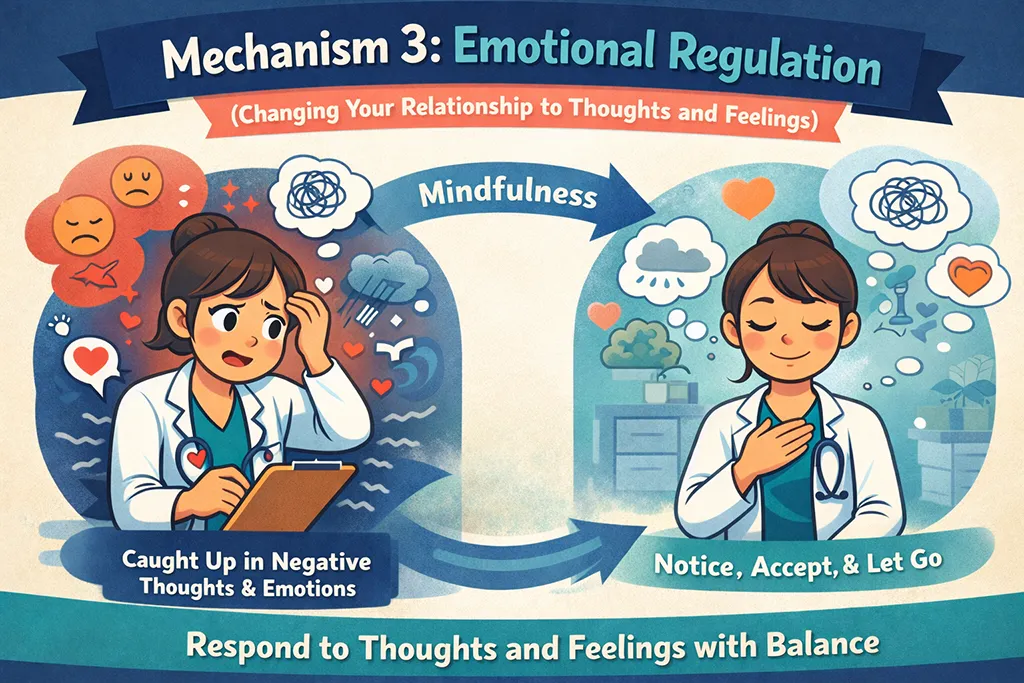
Mechanism 3: Emotional regulation (changing your relationship to thoughts and feelings)
This mechanism is about how you relate to internal experience, thoughts, feelings, doubt, and even physical sensations.
When feelings turn into “facts” at work
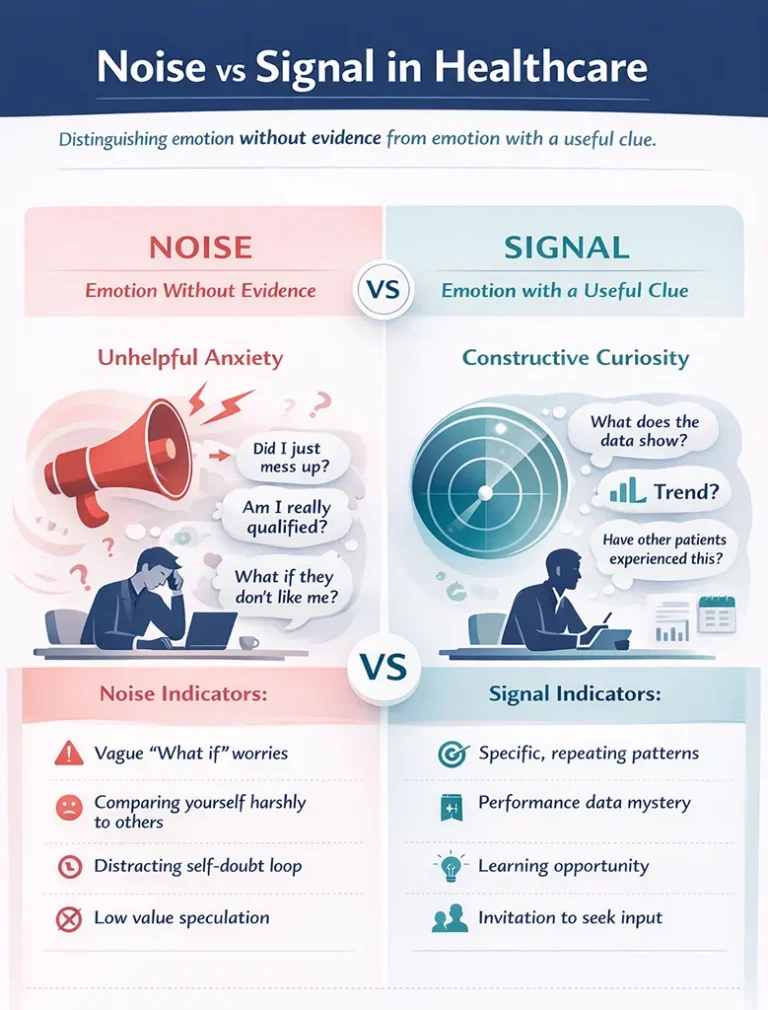
When emotions run high, the brain can treat feelings like facts.
A client is distressed, and you feel pressure to fix everything immediately. A client challenges your plan, and you feel the urge to retreat or over-explain. A moment of uncertainty lands, and self-doubt starts building a story.
Without a skill for working with those moments, you can end up doing one of two things:
You avoid (you don’t want to go there with that client), or you over-function (you try to solve everything right now). Either way, emotional residue can linger. One session bleeds into the next, and later it can follow you home.
For clients, this same loop can fuel symptom distress. Anxiety can amplify body sensations or pain, which then triggers fear and protective tension. The symptoms are real, yet the “danger alarm” can make them feel even more intense.
What mindfulness changes (the “not fused” skill)
Mindfulness builds awareness. More importantly, it builds the ability to observe thoughts and feelings without being fused with them.
That might sound abstract, so here’s the plain version:
You learn to recognise, “This is anxiety, not danger.” Or, “This is a thought, not truth.”
For solo practitioners, this can be especially helpful because you’re often making decisions without immediate feedback from a supervisor or team. It’s easy to go down a rabbit hole where experimentation starts to feel like threat. Mindfulness creates a pause, and that pause gives you options.
How emotional regulation supports better sessions
When you have a little more space around emotions, the therapeutic relationship tends to improve. You can hold boundaries with more ease, without emotional over-involvement. You can also offer compassion without it costing you so much.
It may show up as:
Less dread before a known difficult session. More steadiness during conflict. A quicker rebound after emotionally heavy work. You’re still caring, you just have more room to breathe inside it.
One of the most common clinical models is mindfulness-based stress reduction (MBSR). Here is a clear summary if you’d like to know more, or refer your clients to it.
A quick in-session tool: quiet labeling
Quiet labeling means naming what you’re feeling, silently, in a simple word or two.
For example: frustration, worry, sadness.
You don’t need to analyse it. You’re not trying to talk yourself out of it. You’re just naming it so it stops running the whole show.
A simple process:
- Notice the emotion or body feeling.
- Label it with one word.
- Return to the patient, the breath, or your feet on the floor.
That small act often lowers intensity. It helps you stay present, especially when the session has heat in it.
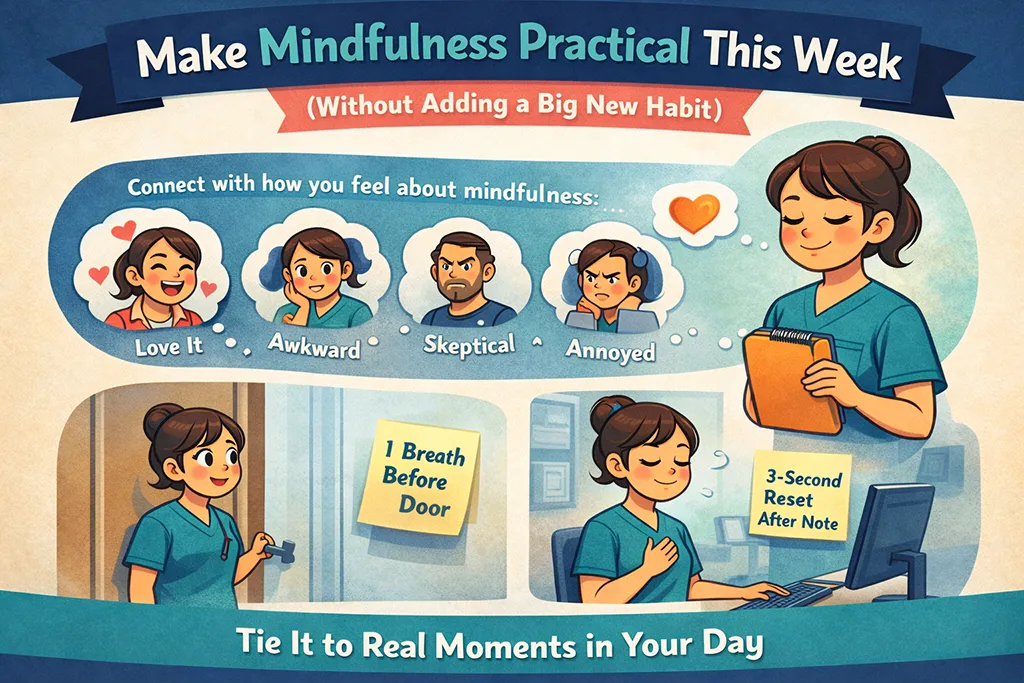
Make mindfulness practical this week (without adding a big new habit)
Mindfulness works best when it’s tied to real moments in your day, not added as a separate “project.” So keep it simple, and make it specific.
First, connect with how you already feel about mindfulness. Some people love it. Others feel awkward, sceptical, or quietly annoyed by it (which is allowed).
If you already use it, think back over the last week. When did it help? Was it attention, a nervous system downshift, or emotional regulation? Was it something different? I’ve focused here on these three mechanisms as most relevant to a clinical setting but there are more.
Write down one example, even a small one. Later, you can share it with patients as a real story rather than a vague recommendation. That can work in one-to-one care, and it can also become a short social post when you’re stuck for what to say.
If you haven’t been using mindfulness, name what’s in the way. Time is one barrier, but it’s not the only one. Sometimes it’s a misconception that mindfulness means “be calm” or “stop thinking.” Sometimes it’s the worry that it will feel too hard.
Try one of these this week:
- Use notice, name, return once a day, ideally between patients.
- Do one minute of box breathing before your first session.
- Practise quiet labeling during a session that feels emotionally charged.
Mindfulness builds a pause. That pause is where choice lives.
Please Share
Have you got a question that I haven’t answered here? Drop it in the comments. This space is for sharing, not just reading. Sometimes the best advice comes from those who’ve been in the same shoes.
Let’s build a supportive community where no one has to figure it all out alone. And if this helped you today, consider passing it on to a colleague who might need it – a little support goes a long way.
Please pin one of these images to your main business tips board