Money Mindset for Practitioners: How to Charge Well and Still Sleep at Night
If you’re a therapist or wellness professional running a one-person private practice, pricing can feel oddly personal. You care about people, you want to help, and you also have rent, taxes, and bills that do not accept good intentions
Here’s the key money mindset for practitioners: being ethical doesn’t mean being cheap. Ethical pricing means you can keep showing up, week after week, with the time, focus, and steadiness your clients came for.
This post walks through a practical, no-sales-team approach to charging well, raising fees with confidence, and keeping access thoughtful (not frantic).
Why ethical pricing has to support your real life costs
Private practice pricing often gets tangled up with self-worth. If you’re a caring practitioner, it’s easy to quietly decide you should be the “affordable one,” or that charging more would make you greedy. It won’t. Running a sustainable business is not a moral failure, it’s a business requirement. Cultivating a solid money mindset from the outset supports lasting success.
Ethics in a clinic setting includes reliability. Clients need to know you’ll still be there next month, that you can keep the lights on, and that you aren’t making choices from financial pressure. A low fee might look kind on paper, but if it creates financial stress, it tends to show up somewhere else.
For example, underpricing can push you into choices that do not support good care, such as packing sessions too close together, rushing notes, stretching your working hours past what’s sensible, or feeling annoyed when a client needs extra explanation. None of that helps the person on the table. It also doesn’t help you.
A steady pricing system supports care because it makes your clinic stable. That matters for your clients and for you. As a business owner, it’s essential to cover your real-life costs.
Here are two simple benefits worth remembering:
If you notice guilt, fear, or second-guessing popping up, that’s normal. The goal is to build a structure that does not ask you to make emotional decisions in the moment.
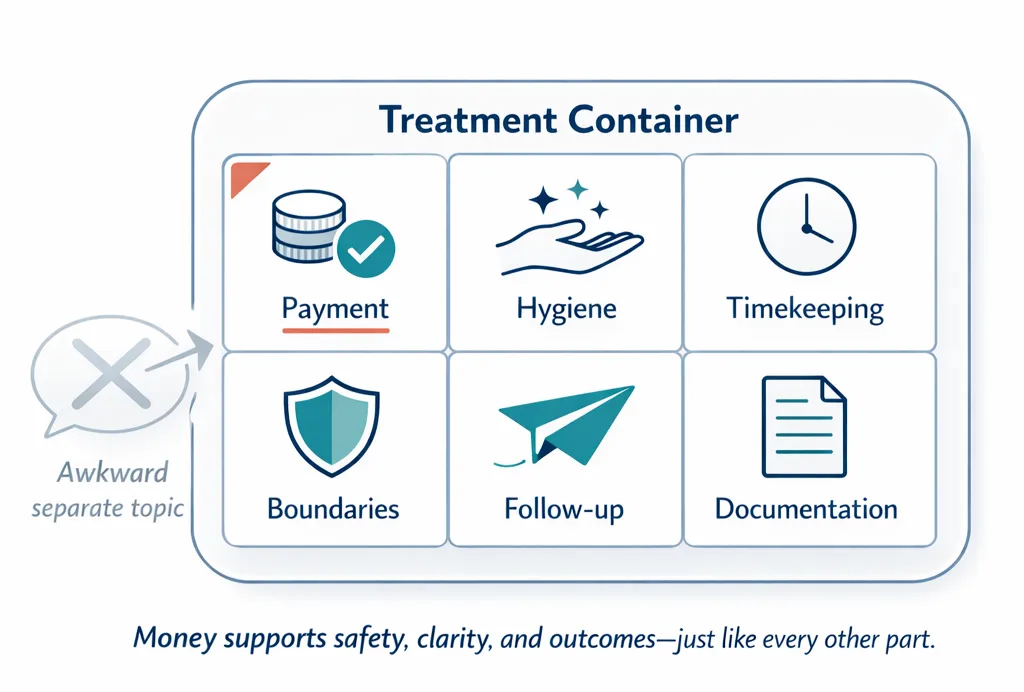
Money is part of the treatment container, not a separate awkward topic
Practitioners’ relationship with money often frames it as an intrusion into healthcare, as if it sits outside the “real work.” In practice, payment is part of the same container as hygiene, timekeeping, boundaries, and follow-up. It’s one of the things that makes your work safe and consistent.
When you treat it that way, money gets calmer. It becomes a policy issue, not a feelings-led debate you have with yourself every week.
Treat money like hygiene, time, and boundaries
Think about how you handle other parts of your clinic container.
You wash linens because hygiene protects the work. You set session lengths because time boundaries protect the work. You have clear professional behaviour because relational boundaries protect the work.
Fees do the same thing. They protect the space where care happens, and they protect your ability to provide it.
This is also why it helps to create a bit of distance from the fee and your money stories. A clear price list, clear policies, and a consistent review process mean you don’t have to improvise. You’re not deciding what someone should pay based on whether they seem nice, upset, or having a rough week (which is most weeks for someone, somewhere).
A few common limiting beliefs show up for caring practitioners grappling with their money mindset:
If your fee does not cover your real costs, your practice becomes fragile. A fragile clinic tends to create pressure, and pressure tends to leak into your sessions.
I got over my discomfort of talking about money with clients by creating myself a few scripts linked to the key times it needs discussing. Having those ready as a natural part of the treatment process made me less nervous about raising money issues and clients just saw it as normal, because it is.
Why clients benefit when your pricing is sustainable
Clients do not only pay for needles, hands-on work, or time on the table. They pay for the experience of being treated as part of a clear, professional system.
They also pay for that measure of comfort and clarity in other areas of life. Many people will spend on things that reduce uncertainty, save time, or make life feel easier. Your work often does exactly that, reflecting an abundance mindset focused on value over cost and tying directly to your self-worth as a practitioner.
It can help to remember this simple truth:
Your fee protects the space where healing happens, it’s part of the treatment plan’s container.
Also, people who want care will spend money somewhere. Your clinic is not competing with “free.” It’s competing with other practitioners including coaches, other wellness spending, and sometimes with coping strategies that cost more long-term.
One line that’s worth keeping in mind, especially when guilt flares up, is this:
“If they don’t pay it to you, they’re going to pay it to somebody else.”
That doesn’t mean everyone can afford every service. It does mean your price deserves to reflect the value and the cost of doing the work properly.
There was a time that I found out a prospective client had gone to a competitor that I knew would not be a good fit. I realised that it was my fault. They’d chosen the other acupuncturist because I’d held back from encouraging the client due to worrying about whether they could afford the fees. They had the money for the fees, they were trying to choose the best person for the job and I’d got in the way of that.
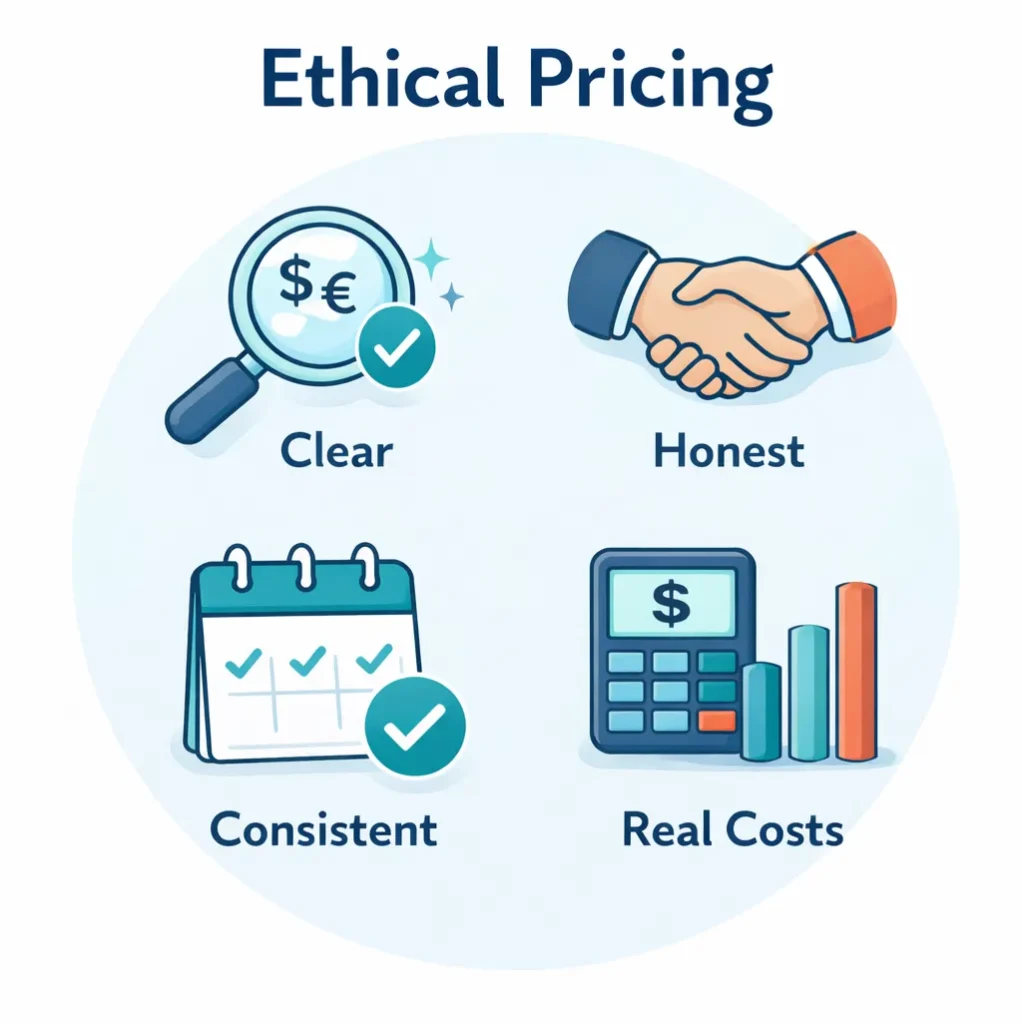
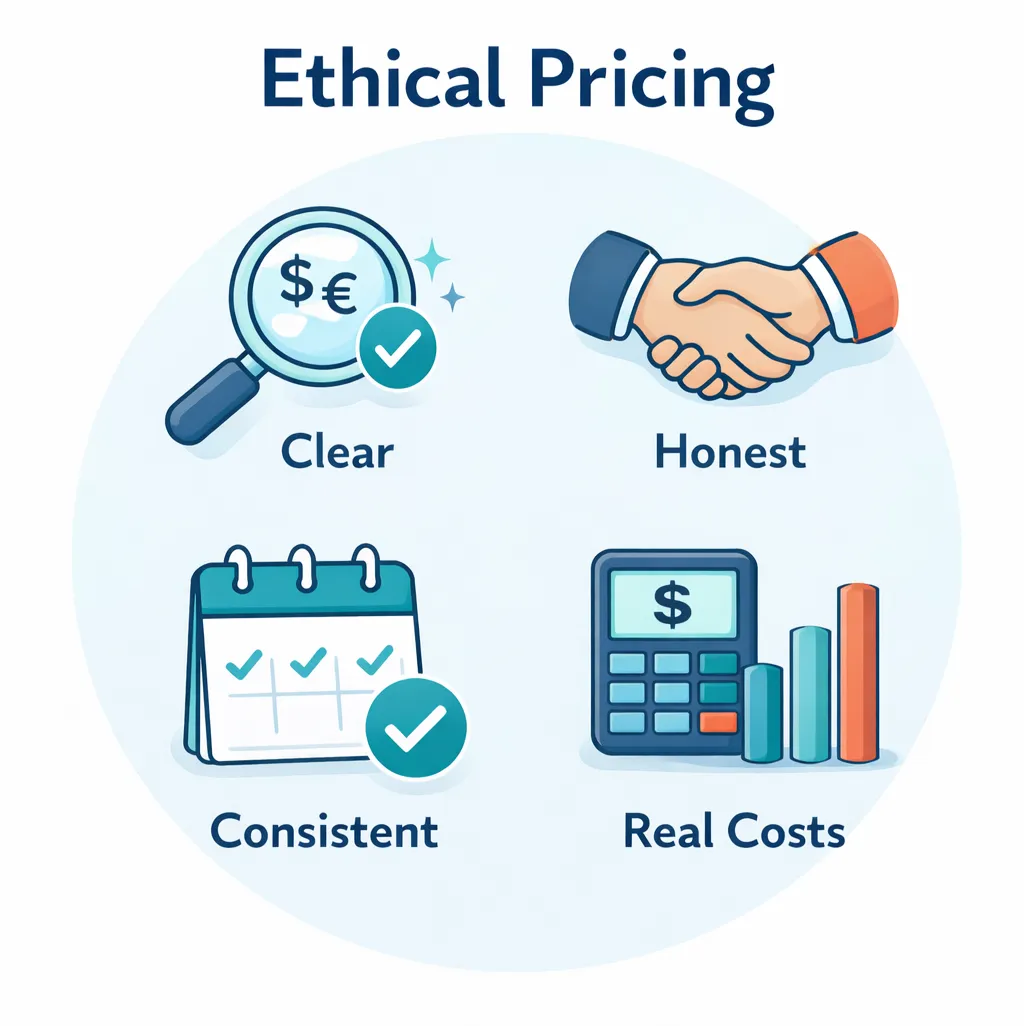
Ethical pricing means clear, honest, consistent, and based on real costs
“Fair” is a slippery word in healthcare. Many holistic practitioners quietly translate fair into “accessible to everyone at all times,” and that’s not actually possible for most solo private practices. Ethical pricing requires an equitable money mindset, grounded in reality.
A good ethical pricing approach is built on four things:
Here’s the uncomfortable but important piece: undercharging can be unethical.
Not because low prices are “bad,” but because chronic undercharging, often fueled by limiting beliefs, leads to rushed sessions, stretched boundaries, resentment about your schedule, and a business that can’t support steady care. Clients pick up on that, even when you never say a word about money.
How your fee protects the healing space (and your client’s trust)
A stable fee does more than keep the lights on. It keeps you consistent.
When you’re not worried about financial stress like paying your rent or taxes, you can focus on clinical decisions as a therapist. You can spend the extra minute explaining aftercare. You can follow through on what you promised. You can keep your boundaries without feeling like you’re being difficult.
There’s another piece that surprises practitioners: underpricing trains clients to undervalue the work, even clients who could pay more. If a fee looks “too low to be true,” some people assume the service is lower quality, that you’re less trained, or that you must be cutting corners.
Your fee is part of your professional identity, whether you like that or not.

Stop pricing yourself against the cheapest option in town
It’s tempting to scan local prices and anchor yourself to the lowest number, especially when you’re building confidence. The problem is that “the cheapest option” tells you nothing about whether that other practice is sustainable, ethical, or even accurately priced.
Instead, price from your own reality first, then compare to your area.
The invisible work your sessions have to pay for
Clients see the treatment time. They don’t see the rest of what makes their care possible.
Your fee needs to cover the full set of work that holds the clinic together, such as:
You can care deeply and charge properly. Both are true at the same time. Also, don’t let a scarcity mindset encourage you to race to the bottom. It rarely ends well.
A reality check method to set your minimum viable fee
If you’ve never calculated what you actually need to earn to meet your financial goals, this can feel daunting (make tea first). Still, it’s one of the kindest things you can do for your future self.
Work through this list of strategic money management costs in order:
- List monthly business costs. Rent, supplies, software, insurance, laundry service, cleaning, anything you pay to operate.
- Add personal income needs. Housing, food, loan payments, savings, transport, childcare, the basics of your life. Consider frameworks like Profit First for managing business income.
- Include taxes. Even if you don’t pay them monthly, they will show up. Plan for them now.
- Divide by realistic billable sessions. Use the number you can genuinely deliver, not the fantasy schedule that ignores admin and rest days.
That last step matters most. A solo private practice has a limit, unlike group practice owners. Your fee has to match your actual hours, because you can’t sell 40 hours of sessions and still do your notes, marketing, cleaning, and life admin (unless you’ve found a way to add extra days to the week, in which case, share your secrets).
If you want a broader structure for mapping income needs alongside the rest of your clinic plan, this guide is a helpful companion: setting weekly income targets.
Once you have your “minimum viable fee,” compare it to local rates. If your number is higher than your area average, that’s a signal to look at your business model (session length, service design, costs, or how you package care). It’s not a signal to quietly undercharge and hope for the best.

What your fee signals to clients (even before they meet you)
People read pricing like a story that reflects your money mindset.
If your fee is extremely low, some clients won’t think “how kind.” They’ll think, “What’s missing here?” That might feel unfair, but it’s common.
A clear, confident fee tends to signal:
On the other hand, inconsistent pricing or constant discounting can make clients uneasy. They might wonder why the price changes, what the boundaries are, or whether you’ll still be practicing in six months.
Here’s the line to keep in your back pocket:
Your fee is not just a price, it’s a signal.
You’re allowed to send a signal that says, “This clinic is stable, and your care will be consistent.”

Raising prices without feeling like a baddie
Avoiding a price increase is usually about fear of losing clients. That fear makes sense. Still, a sustainable clinic needs regular review to support building wealth as a long-term professional goal, and most industries raise prices over time, including healthcare.
The goal is not to “convince” clients. The goal is to have a simple, ethical process you follow without drama.
Use a calm, repeatable process (and stick to your date)
Pick a review rhythm that works for you. Some practitioners review fees at the end of the tax year. Others look every six months, especially when costs rise quickly due to changes in insurance panels.
A straightforward approach looks like this:
- Choose the new fee and the start date. Make a decision you can stand by.
- Give current clients notice. Two to six weeks is a common window, depending on your setting. Many solo practitioners land around four to six weeks.
- Keep the message short. Say what’s changing, when it starts, and why (in one sentence).
You don’t need to apologise, and you don’t need a long explanation. Overexplaining often signals imposter syndrome and sounds like you don’t believe in your own fee.
Here’s a script you can adapt:
Starting on (date), my session fee will be (X). This keeps the practice sustainable and supports the level of care I provide.
Then stop. Let it be normal. Because it is normal.
I used to update my prices in line with the new tax year starting. I’d start mentioning it 4-6 weeks out for my regular clients, on the session immediately before the increase. That way they knew when booking their next session what the fee would be. My newsletter also mentioned the increase in plenty of time. No-one was hit with a surprise bill and everyone knew that it applied equally across my client list.
Build an access plan on purpose, not in a panic
If part of you worries about clients who may not be able to afford you after a price increase, that’s a values question rooted in an equitable money mindset, and it deserves a plan.
Accessibility works best when you decide ahead of time what you can offer, and how many spaces you can afford to allocate.
A few options you might choose from:
The key point is simple: accessibility should be a plan, not a reaction to guilt.
Put policies in place that carry the pricing for you
Good boundaries reduce awkward conversations because they remove guesswork.
If you want your pricing to hold steady, your policies need to hold steady too. That usually includes a cancellation policy, late policy, and payment due at the time of service. If you offer receipts or insurance paperwork, set clear rules about how and when you provide them.
Clients don’t need a lecture, but they do benefit from a short explanation: consistent policies protect the clinic, and that protects continuity of care.
When you treat your policies as part of the clinical container, they stop feeling like “business stuff” and start feeling like basic professional practice (which they are).
Common pricing objections, with simple responses ready
It helps to prepare one or two sentences for the objections that tend to come up. Keep your tone calm, and keep your wording neutral. You’re not arguing, you’re informing; this confidence draws from your self-worth.
Here are a few common ones:
|
Objection |
A clear, calm response |
|---|---|
|
“I can get it cheaper elsewhere.” |
“That makes sense. If price is the main factor, that option may fit better for you.” |
|
“Why is it so expensive?” |
“You’re paying for my time, my training, and the full session experience, including what supports safe care.” |
|
“Can you make an exception for me?” |
“I can’t adjust the standard fee, but I can talk you through options like a package, if that suits your plan.” |
If someone chooses to leave, let them leave gracefully. It’s not a good idea to change your prices because a client threatens to go elsewhere. That trains your practice to run on pressure, and it puts you back in the feelings-led pricing loop you’re trying to escape.
Your next steps: set a fee that supports you and your clients
Sustainable fees come down to a few steady habits; this financial philosophy means charging based on real costs, reviewing your fees regularly, and communicating changes simply. A sustainable business helps clients because it stays consistent, and it helps you because your work stays grounded in reality.
Pick one action to take this week. Check when you last raised prices, run your cost calculation, or choose a date for your next review. Then write the one-paragraph client message now, while you’re calm.
Most importantly, you should adopt a money mindset and treat your fee as part of care, not an apology you have to make. When pricing supports your clinic, your clients get the stable, professional service they came for.
Please Share
Have you got a question that I haven’t answered here? Drop it in the comments. This space is for sharing, not just reading. Sometimes the best advice comes from those who’ve been in the same shoes.
Let’s build a supportive community where no one has to figure it all out alone. And if this helped you today, consider passing it on to a colleague who might need it – a little support goes a long way.
Please pin one of these images to your main business tips board