From Burnout to Breakthrough: Escape the Burnout Loop and Build a Sustainable Growth Loop
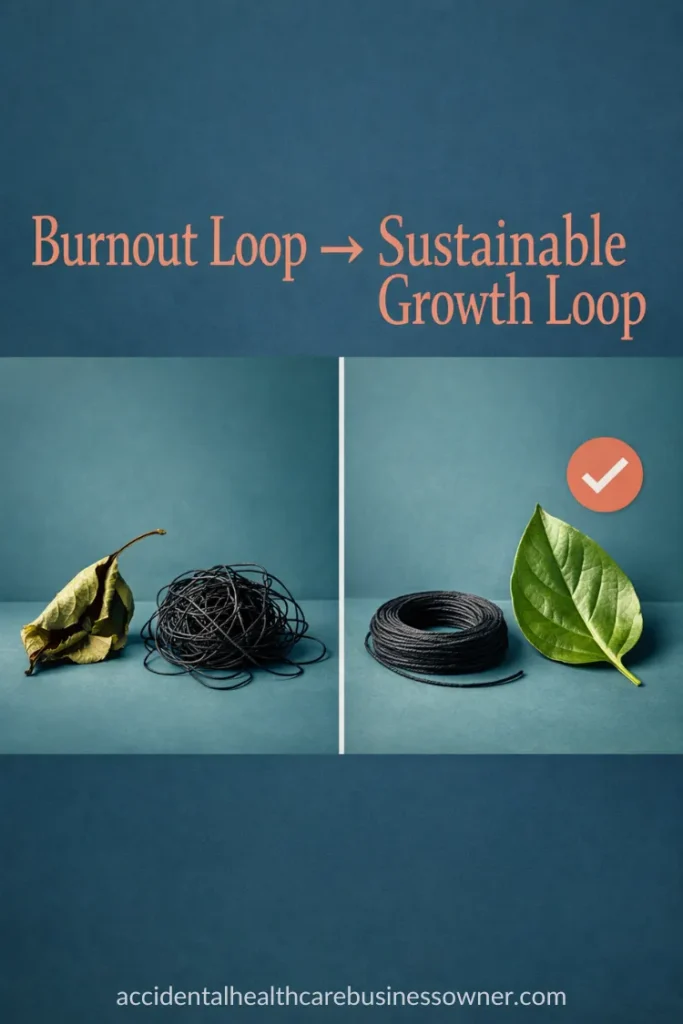
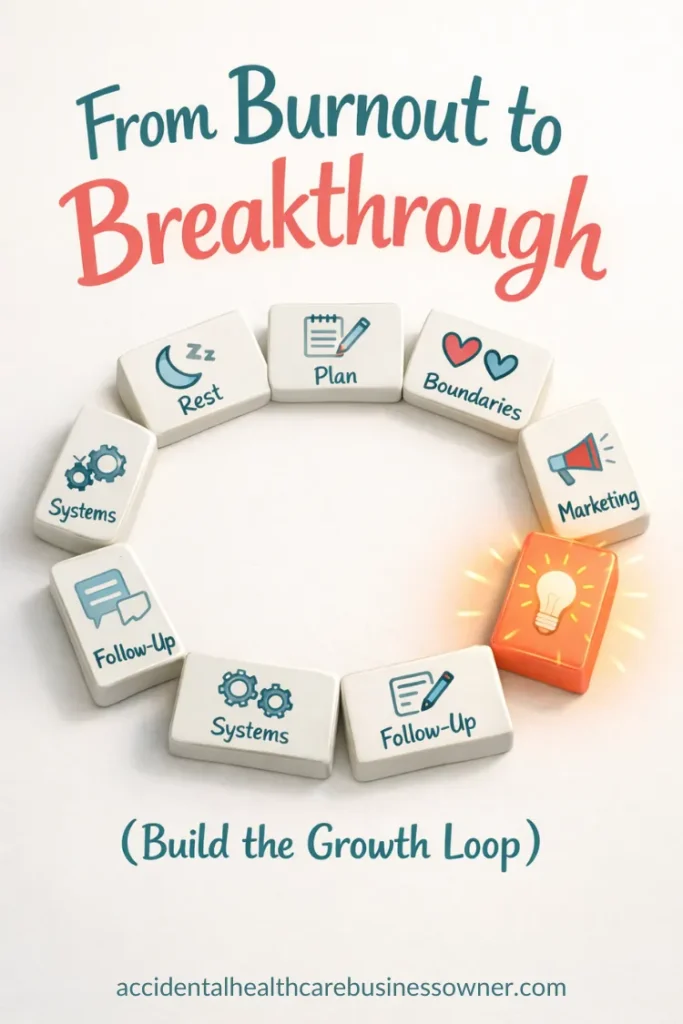
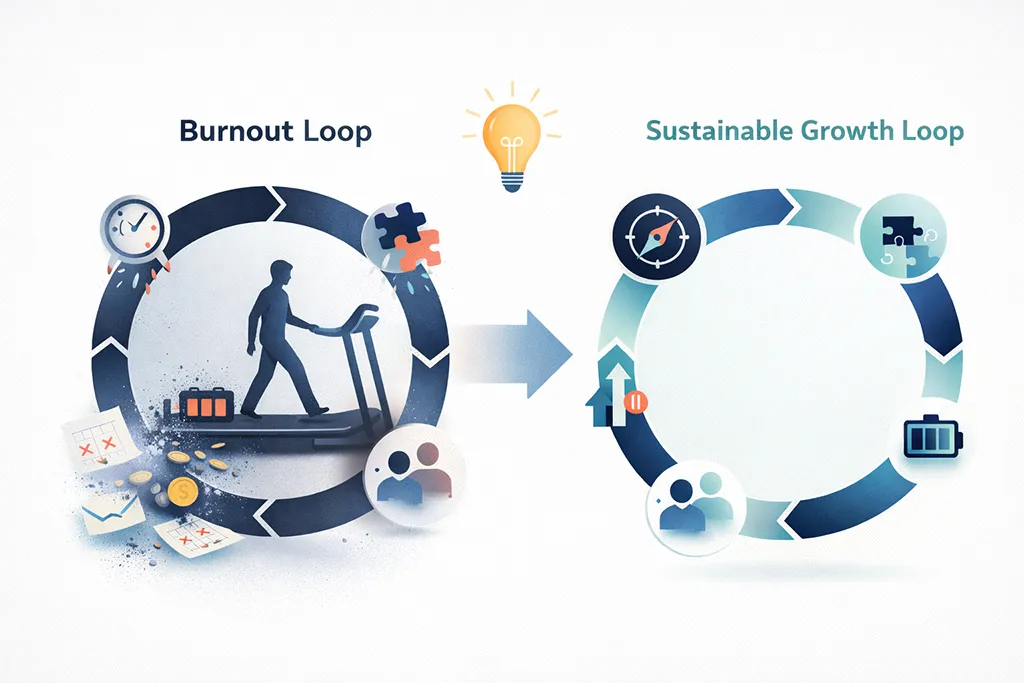
The burnout loop is sneaky, it rewards effort, not results. You post, you chase, you squeeze in patients, then you crash, and the cycle starts again. In this post, you’ll learn how to switch from hustle-based growth to a sustainable loop built on clear offers, simple marketing, and a small set of weekly actions you can actually keep up with. We’re here to build a sustainable growth loop, not win an endurance contest.
A few signs you might be stuck in an unhelpful cycle:
The good news is you don’t need a dramatic overhaul. Small changes can create a loop that gives back to you.
The burnout loop in a solo clinic (the vicious circle)
I mentioned the burnout loop versus the growth loop in the overview of practitioner mindset that I did. And, now we’re going to dig a little deeper into it.
A vicious circle is a chain of cause and effect where the elements intensify and aggravate each other making the situation worse. In solo practice, it can look innocent at first. You’re busy. You’re needed. You’re booked. From the outside, it can even look like success.
Then the pattern sets in.
It often starts with overbooking. When income is inconsistent, it’s tempting to say yes to every appointment because “what if next week is quiet?” That decision makes sense in the moment. The problem is what it triggers next.
More appointments create more admin and that’s your job too. Notes, reminders, invoices, rebooking, supply orders, inbox triage, referral letters, payment issues, and the small client questions that are totally reasonable (but still take time). Admin then piles up, so you push it into the evening. You tell yourself it’s temporary.
The worst part is what gets squeezed out. You lose the space that would help you fix the pattern, like planning time, systems improvement, and actual rest. Instead, you end up reacting all day, putting out fires, and hoping next week will be calmer.
Here’s the simple contrast that makes it easy to miss:
Outside: busy and booked. Inside: stuck, tired, and dragged around by the calendar.
This is why “I’ll sort it when I catch up” rarely works. Catching up requires time and energy, and the burnout loop uses up both.

The hidden costs of staying on the treadmill
You can keep things going for a while in this mode. Most practitioners do, because you’re capable and you care. But the costs show up quietly at first, then all at once.
The first cost is clarity. When your brain is full of urgent tasks, the important decisions get delayed. You might know you need to tighten your intake process, clean up your diary rules, or stop doing a certain admin task manually, but you can’t think long enough to choose the best fix. So you keep doing what you did last week, even if it’s not working.
The next cost is quality. Clients feel energy, even when you’re trying hard to hide it. If you’re rushing between rooms or running late, the session can start to feel compressed. Your patience can get shorter. Your presence can get thinner. That’s not a character flaw, it’s a capacity issue.
Then you lose real growth. When you’re running on fumes, you can’t build anything that lasts. Systems, client experience improvements, and simple marketing routines all need a little consistent attention. If you never have that, your practice can’t mature. It just keeps producing the same week again and again.
Finally, you hit a ceiling. You can’t scale past your own capacity when every extra client also creates extra admin.
A quick way to name the costs looks like this:
- Clarity drops because decisions get pushed aside.
- Client experience dips because rushed energy leaks into the room.
- Progress stalls because there’s no space to build lasting improvements.
- The ceiling arrives because more appointments only make the week heavier.
Adding more clients stops helping, it just adds weight to your admin load.
The fix isn’t “try harder.” It’s changing the loop.

The sustainable growth loop (a virtuous circle that gives you space)
A virtuous circle is the opposite of a vicious circle. Cause and effect still build on each other, but this time they create improvement instead of pressure.
The key mindset shift is simple: growth should create more space, not less.
This isn’t about designing the perfect week where you wake up early, meditate, write content, reply to every email with a smile, and then float through your day (wouldn’t that be lovely). It’s about building a structure that works in a standard work week, while you’re still seeing clients and living your life.
A sustainable growth loop has a few core features:
Over time, this loop tends to create steadier income, clients who feel well cared for (and recommend you), and time off that actually feels like time off.
Three practical shifts that move you toward a steadier week
These shifts are designed to work while you’re busy. No shutting the clinic for a week. No giant project plan. Just changes that fit into real life.

Shift 1: Own your time like a CEO
If you’re a solo practitioner, you are not “just” a clinician. You’re also the person running the business. If you don’t claim time for that role, it gets shoved into evenings, weekends, or never.
A simple starting point is to block one hour a week as CEO time. If an hour feels unrealistic right now, start with fifteen minutes. What matters is that it’s protected.
Treat that block like your most important appointment, because it drives everything else.
A simple CEO time agenda can be short and plain:
- Review last week’s schedule. What caused stress, and what worked well?
- Choose one fix for this week (just one).
- Confirm your top three priorities, then stop.
This is also where a basic plan helps. Not a 30-page document, just a clear sense of who you help, what you offer, how you find clients, and what you need to earn. If you want a practical guide for that, this is a good companion: power of a straightforward business plan.
CEO time is how you stop living inside your diary and start directing it.
Shift 2: Build energy buffers with passive offers
Passive offers are breathing room. They are not a new full-time job.
For hands-on practitioners, passive offers usually mean resources you create once and can share many times, without needing to repeat yourself in a live session.
A few simple examples:
The point here is not to become an online course creator overnight. It’s to create a buffer. Something that supports clients between sessions, gives value to people who can’t see you in person, and adds income that isn’t directly tied to hours in the room.
I created a short course on how to improve sleep, as it was a topic of benefit to so many of my clients. As well as video training modules, it included a sleep hygiene checklist, sleep tracker and breathing exercise audio files. I could break it apart for use with clients or sell online as a bundled product.
Start with one small offer and let it run for a while. If you try to build three at once, it stops being “passive” pretty quickly.

Shift 3: Clarify your purpose and say no to off-mission work
This shift isn’t about saying no to clients. It’s about saying no to extra tasks that create noise in your week.
When you don’t have a clear purpose, you can end up chasing every marketing idea that sounds smart. You start marketing on a new platform, then abandon it. You rewrite your message every week. You create content for three different client types, then wonder why none of it feels coherent.
A practical way to tighten this is to define your purpose in plain language by focusing on the transformation you’re best at delivering.
For the next 90 days (three months), choose:
You still treat people outside that focus, because real clinics aren’t that neat. The “no” is for the marketing tasks and extra projects that don’t match your chosen outcome.
This tends to help in three ways. Your marketing gets more confident because the message is clear. Your content gets easier because you’re not reinventing the wheel every time. Your schedule feels less chaotic because you stop adding random, draining tasks that don’t move the clinic forward.
A 5-day, 15-minutes-a-day reset to get started
This is not an all-or-nothing reset. It’s a gentle start, designed for people who are already carrying a full week.
Keep it to fifteen minutes a day for five days. Don’t “power through” and turn it into a two-hour project. Your nervous system will notice and complain (usually at 2 a.m. when you might need my better sleep course).
Here’s the plan:
After day five, you’ve got options. Repeat the same five-day cycle and tighten another system, or add another small block of CEO time each week. The win is consistency, not speed.
Next steps that protect your time (and your clients)
If you want a phrase to keep on a sticky note, use this: growth should give you space.
Claim CEO time, even if it’s fifteen minutes. Add one passive offer as a buffer, not as a second job. Choose a clear focus for the next 90 days, then say no to work that doesn’t fit.
If you’ve been thinking about how your workload is overtaking you as a solo health practitioner, treat this as your permission slip to start small and still take yourself seriously. Your time is precious, and your practice should support your life, not eat into it.
Please Share
Have you got a question that I haven’t answered here? Drop it in the comments. This space is for sharing, not just reading. Sometimes the best advice comes from those who’ve been in the same shoes.
Let’s build a supportive community where no one has to figure it all out alone. And if this helped you today, consider passing it on to a colleague who might need it – a little support goes a long way.
Please pin one of these images to your main business tips board