Practitioner Mindset: How to Create Sustainable Growth in Your Solo Health Practice
You can be an excellent clinician and still feel like your practice is running you.It usually isn’t because you’re doing something “wrong.” It’s because the business side keeps expanding, and your brain keeps trying to meet that pressure by working longer, squeezing more in, and saying yes when you meant no.
That’s why practitioner mindset matters so much. It quietly shapes how you use your time, how you carry personal responsibility, and what you believe “good care” looks like. It also decides whether the systems and marketing you set up will hold, or slowly fall apart the moment you get tired.
If you’ve been building the practical stuff first (intake, admin, growth), this is the piece that makes your professional growth sustainable. It’s the part that helps you keep going without resenting your calendar.
Why practitioner mindset belongs alongside systems and client growth
So far on our journey, the focus has been on two categories of knowledge. I’ve been covering business foundations, (eg. intake processes, scheduling, and managing admin), and client growth, (eg. attracting new patients, creating a clear offer, and building an online presence).
We’re going to continue to build those out over time, but today I’m adding a third pillar, which is around practitioner mindset.
Those first two pillars are practical, visible, and easier to “tick off.” Your mindset is less obvious, but it’s the thing that decides what happens under pressure.
Here’s the key idea to hold onto:
Sustainable growth starts with how you think about time, responsibility, and good care.
If you believe you must be endlessly available to be a “good” practitioner, you’ll design a week that drains you. If you believe rest is something you earn after you’ve caught up, you’ll never catch up. If you believe clients will only stay if you over-deliver, you’ll keep stretching sessions, then scrambling to finish notes at night.
Mindset affects everything else you do. It shapes what you say yes to, what you tolerate, and what you think you “should” do, even when it costs you your health (and, long-term, your client care too).

The trap of not protecting your time (and the hidden costs you don’t see at first)
It’s common to start out knowing, at least in theory, that you need boundaries around time. Then reality hits.
You might recognize this pattern: a fellow solo practitioner is booked wall-to-wall because she felt she needed to run the clinic as many hours as possible to make the income. Each week she’s up late catching up on paperwork, chasing admin, and telling herself she’ll learn that new process or tool “when things calm down,” all while grappling with these real-world problems.
Except things don’t calm down. They stack.
And the costs show up in sneaky ways, not always as a dramatic crash. They show up as slow leaks:
This is where “I’ll just do more hours” stops looking like dedication and starts looking like poor risk management. Because when you don’t protect your time and health, your clients don’t win either.
A steadier approach is to plan with business ownership in mind. You’re not just a practitioner, you run a business. By now you already know there’s an admin cost to everything: notes, emails, stock, booking issues, accounts, and the mental load of problem-solving as the person who decides.
When I set up my acupuncture practice, I opted to work part-time clinically as a deliberate choice, not a lack of ambition. It helped me create a structure that kept my care consistent.

What practitioner mindset really is (and why it beats willpower)
Practitioner mindset isn’t about being positive all the time. It’s much more practical than that.
It’s the set of beliefs that decides what you say yes to, what you tolerate, and what you think you should do. Systems matter, marketing matters, pricing matters, but mindset is what determines whether you keep those things going, and whether they actually match your life and values.
A solid practitioner mindset lets you hold two truths at once, embracing a growth mindset:
That second part can feel uncomfortable at first, especially if you got into healthcare because you genuinely care (which you did). But unlimited giving doesn’t create unlimited good care. It creates fatigue, rushed decisions, and a business that depends on you running on fumes.
Burnout often comes from a mismatch. Your values are high, but your capacity is human.
If you’ve ever thought, “I just need to be more disciplined,” consider this: a fixed mindset relying on willpower is a terrible long-term business plan. Mindset is what helps you set up repeatable actions that don’t require you to fight yourself every day.
The three mindset layers that run your practice: identity, beliefs, habits
Mindset starts to make sense when you break it down into parts. In day-to-day practice, three layers stack like a simple ladder. When the top rung feels shaky (your habits), it helps to check what’s underneath.
- Identity (your internal label): This is the story you live from. If your identity is “I’m the practitioner who always goes above and beyond,” you’ll feel guilty every time you set a boundary. If your identity is “I’m an effective clinician and a profitable business owner,” you’ll protect time because it protects your care.
- Beliefs (your rules about care and money): Some beliefs are useful. Some are inherited. A belief can sound noble while still hurting you. For example, “good care means unlimited time” sounds compassionate, but it trains you to overrun.
- Habits (beliefs with legs): Habits (beliefs with legs): Habits are what you do on repeat through iteration. They show up in your schedule, policies, charting, and follow-up. If you believe good care means unlimited time, your habit might be squeezing in “just one more thing,” running 10 to 20 minutes late, then apologizing again.

What a steady mindset gives you (it’s boring, and that’s the point)
A steady mindset does something that is both boring and wonderful. It helps you choose repeatable actions, protect your energy, and keep the client experience consistent.
Consistency is what makes growth sustainable. Not hustle. Not big bursts of effort followed by collapse.
When your mindset is steady, it becomes a filter. It decides what you start, what you avoid, and what you repeat. That filter protects you from building a practice that only works when you’re over-functioning.
And if you want a practical way to support that steadiness, it helps to plan in a simple, clear way (simple is your friend when you’re busy). This guide to a simple business plan for your health practice fits well here, because clarity reduces the pressure to “wing it” in your head at 10 pm.
The mindset topics that stop you getting stuck (and what you’ll work on next)
Mindset work shouldn’t feel like homework that steals more time. It should make your week feel lighter by clearing roadblocks, even if nothing in your clinic schedule changes yet.
The focus here is on identifying the specific thought patterns that pull you into overwork, avoidance, or guilt, then replacing them with beliefs and habits you can actually keep.
These are some of the topics that we’ll be exploring within the practitioner mindset theme.
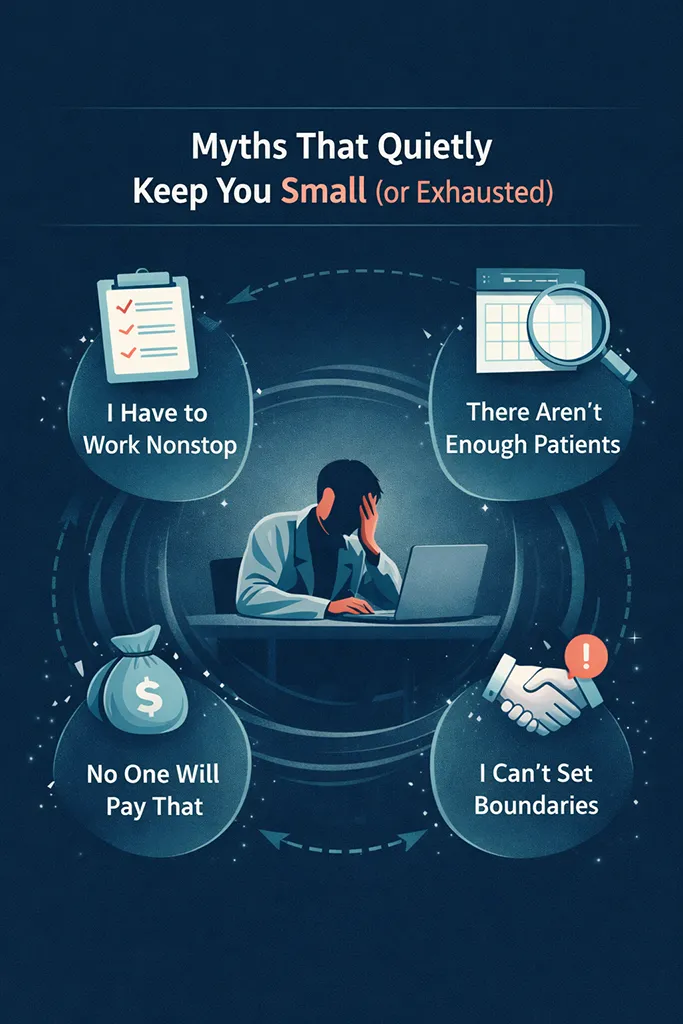
The myths that quietly keep you small (or exhausted)
Some of the most common myths sound responsible on the surface, which is why they’re so sticky.
You might hear yourself thinking:
Both can lead to the same outcome: you do everything yourself, you hesitate to talk about your services clearly, and you carry the pressure in silence.
The cost isn’t only tiredness. It can also be missed chances to help people who genuinely need you, because they lack the industry knowledge to understand what you offer or how to start.
Reframing matters here, but it has to be yours. I’ll give you suggestions for thinking differently, but if a new belief doesn’t feel true in your body, it won’t stick. The goal is to find a version that you can stand behind on a normal Tuesday, not just on a motivated morning.
The burnout loop vs the growth loop (small changes beat big bursts)
Burnout often follows a loop: you overwork, you fall behind, you try to catch up by working more, then you get even more behind. The loop tightens.
The growth loop is calmer. You notice what pushes you into the burnout pattern, then you make small changes you can keep doing while still seeing clients. Not dramatic clinic-wide overhauls. Not “take a month off and rebuild everything.”
Small changes are more realistic when you’re time-poor. They also build trust with yourself, which is a bigger deal than it sounds.

Self-care as a business strategy (not a reward for surviving the week)
Self-care isn’t something you earn after you’ve done enough. It’s part of how you protect your ability to care well.
In healthcare, this matters twice:
- It helps you stay well (obvious, but easy to ignore).
- It helps your clients because you model what you recommend.
If you tell clients to regulate their stress, but your life shows them stress is unavoidable and rest is optional, it’s hard to teach with integrity.
Self-care also isn’t one-size-fits-all. If you’re very stressed, starting meditation might feel impossible. But you might be able to take 5 to 10 minutes to listen to music that shifts your state. Something uplifting that makes you want to move, or something soothing that helps you wind down.
A hands-on approach to trying different options gives you more tools to suggest to clients. It also gives you honest language, because you can say, “This helped me when I couldn’t face anything complicated.”
Over time, we’ll consider self-care tools and products that can be offered for free, and we’ll also take a look at some that could be offered as paid extras.
Boundary setting and imposter feelings (useful signals, not character flaws)
Boundaries protect your time and energy, but they also protect the experience of every client who comes after the one in front of you.
If you let appointments overrun, the next client gets pushed back. Then you’re flustered, you’re apologizing, and your whole day starts to feel like a sprint.
Boundaries can also help your clients. When you model clear limits, you show them what healthy limits look like in real life. That’s not cold, it’s teaching.
Imposter syndrome fits into this pillar too. Instead of treating it like proof you shouldn’t be doing the work, you can treat it as information. It can point you toward the training or support in technical skills that would help you feel steadier, without sending you into an endless cycle of panic-driven courses in place of methodical research.
I’ll suggest strategies and priorities for you to consider but this is your business. You know what fits and what doesn’t. If a suggestion doesn’t feel right to you then discard it or circle back to it at a later date.
Your next steps for a steadier practitioner mindset
I don’t have any major homework for you to do today, but I do invite you to share with me what your main mindset issues are.
Start by noticing your main mindset pressure point. The one that causes the most trouble in your week. It might be:
Either drop me a comment or email me if you prefer to keep things private. I promise I read every email and I can rearrange the order of my topics if there’s a theme that is coming up often and responses that I see.
Sustainable growth doesn’t start with doing more. It starts with thinking in a way that protects the parts of you that make your care good.
You’re building a practice that has to hold you, not just your clients. That’s the point.
Please Share
Have you got a question that I haven’t answered here? Drop it in the comments. This space is for sharing, not just reading. Sometimes the best advice comes from those who’ve been in the same shoes.
Let’s build a supportive community where no one has to figure it all out alone. And if this helped you today, consider passing it on to a colleague who might need it – a little support goes a long way.
Please pin one of these images to your main business tips board