A Simple Review Routine for Solo Health Professionals: Get Honest Reviews That Run in the Background
If asking for reviews makes you cringe a little, you’re not alone (most kind, competent clinicians feel the same). A simple review routine gives you a clear script, a sensible timing plan, and a way to handle requests that doesn’t feel pushy. You’ll learn how to get more Google reviews and testimonials with less effort, while keeping things ethical and client-friendly.
This post gives you a clear plan: set up the basics, pick the right place to collect reviews, ask at the right moment using a short “trigger phrase”, and keep everything ethical and low-pressure.
Why honest reviews matter more than perfect ones
You don’t need perfect reviews. You need real ones.
When someone is choosing between three local acupuncturists, massage therapists, physios, or chiropractors, they’re usually trying to answer simple questions: “Is this person legit?”, “Will I feel safe there?”, “Do they get results?”, “Will I be judged for asking something basic?” Reviews help them decide.
The funny thing is that overly polished reviews can work against you. You’ve seen them, the ones that sound like marketing copy. They don’t build trust because they don’t feel human. A genuine review might be short, a bit messy, and full of everyday language. That’s often the one that makes a new client think, “Okay, this sounds real.”
It’s also completely fine to ask for a review. Asking isn’t the same as pressuring. You can request feedback while staying kind, calm, and professional. You can even send a gentle reminder, as long as you keep it ethical and follow the rules that apply to you (your local laws, your governing body, and the platform you’re using).
The real goal is a steady flow of reviews, not a panicked scramble when you notice your last review was from 2022. A simple routine means:
You ask at the right time, not randomly.
Your links work, so clients don’t get stuck.
You stay consistent, so reviews keep coming in without a big “review push”.

Get your foundation right before you ask anyone
Before you ask your first client, check that the path from “Yes, sure” to “Review posted” is smooth. If you’ve ever built up the courage to ask for something and then realised the link is broken, you’ll know why this matters (it’s like inviting someone into your clinic, then finding the door’s stuck).
You’re not aiming for perfect. You’re aiming for “works every time”.
Pick your main review platform (keep it simple)
Start with one main platform. For most local clinics, that’s your Google Business Profile because it’s where many people look first when searching nearby.
Then pick one or two backup platforms based on your niche and where your clients already hang out. Options might include:
Facebook, if your community uses it and you already have a page.
Healthgrades, if you’re in the US and your clients search there.
A professional directory run by your governing body (for example, an acupuncture council directory).
Yelp, if it’s popular in your area (but be aware it can come with quirks and drawbacks).
When I was in practice I had my Google Business Profile, my FB page and a listing in the directory managed by the British Acupuncture Council
Keep this part simple on purpose. If you ask people to leave reviews in five different places, they often leave reviews in none. You’ll also end up maintaining five profiles, which is a slow drip of admin you don’t need.
Verify your profiles so links always work
Once you’ve chosen your platform(s), check the details. This is the “good enough” setup that prevents confusion.
Make sure you have:
The point is simple: when a client clicks your review link, they should instantly recognise they’re in the right place. No hesitation, no second guessing, no abandoned review.
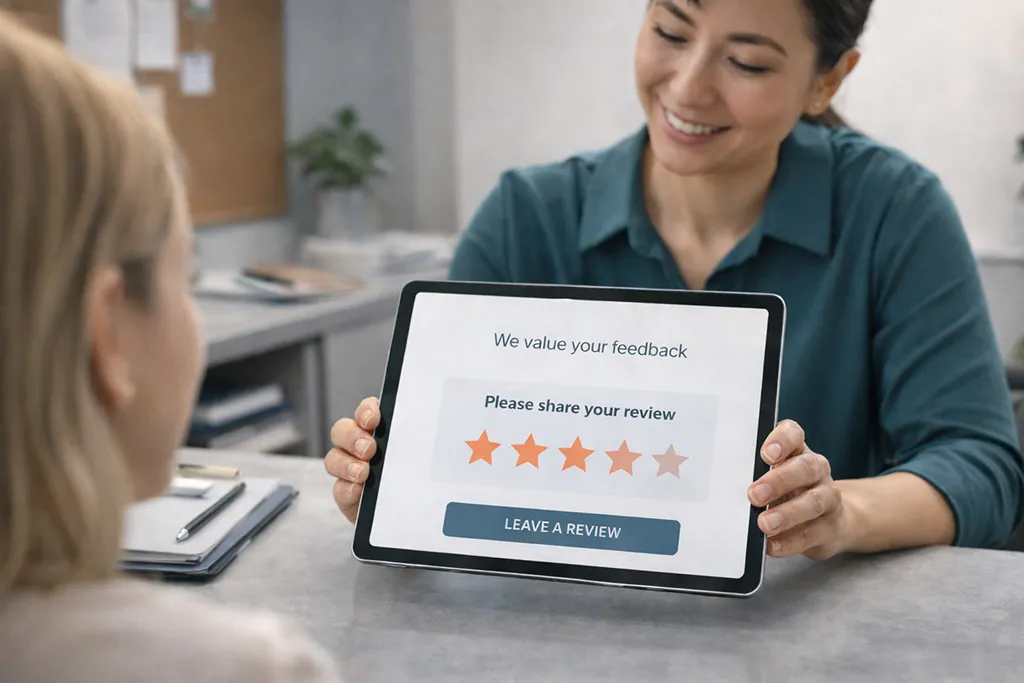
Make review requests part of your everyday client experience
The easiest way to ask for reviews without feeling weird is to make it part of what already happens, not an extra task you bolt on when you remember.
Think of it like washing your hands between clients. You don’t wait until you “feel like it”. It’s just built in. Reviews can work the same way.
Choose the best timing with a trigger phrase
Timing matters. If you ask at the wrong moment, even a happy client might freeze. If you ask at the right moment, it feels natural.
Common “right moments” include:
To make it easy on yourself, use a trigger phrase. Something short that you can say without psyching yourself up.
A simple example is:
“If today felt helpful to you, would you be open to leaving a quick review on Google?”
Then stop talking (yes, really). Silence gives them space to answer. You can add one calm reason if you want, like “It helps other local people find me”, but keep it brief.
This approach also keeps things honest. You’re not asking for a “good” review, you’re asking for an experience.
How to ask: in person or with a follow-up message
You’ve got two main options, and both can work.
If you ask in person, you can read body language. Sometimes a client hesitates because they don’t feel better yet. Sometimes they hesitate because they don’t know how reviews work, or they’re worried about what to write. In person, you can tell which is which.
If you ask via text or email, do it as part of a normal follow-up, not as a random review request dropped into the void. The follow-up can be kind and simple, and the review request can be a small part of it.
Here are a few swipeable examples you can adapt.
Hi [Name], thanks for coming in today. I hope you’re feeling a bit lighter after your session. If you have a moment, I’d really appreciate a quick review on Google. Even a short note helps other people find care. [link]
Hi [Name], it was good to see you today. If today felt helpful, would you be open to leaving a quick review? Here’s the link: [link]. No pressure at all, and thank you either way.
Hi [Name], just checking in after your appointment. If anything feels off, reply and let me know. If you’re feeling better, a short Google review would mean a lot. [link]
If you’re going to use a follow-up, send it within 24 hours, while the experience is still fresh.

Make it frictionless with links and QR codes
A good review routine lives or dies on convenience. If it takes effort, people put it off and then forget.
Use a direct link to your review form (your platform eg. Google Business Profile, will usually give you one). Then place it where clients already look, such as:
You’re aiming for “tap, type, post”, not “search, log in, give up”.
What to say (and avoid) to keep reviews ethical and real
You can get more reviews without turning them into a performance. The goal is to invite honesty, reduce the “what do I write?” worry, and stay well inside the rules.
Gentle scripts that encourage sharing
Some clients need reassurance that a review doesn’t have to be a novel.
Try language like:
“Would you share your experience? It helps local people find care. Even a short note is helpful.”
That last line matters. People often get stuck because they think they need to write something profound. Giving them permission to keep it short makes it easier to start.
Steer without scripting (simple prompts that help)
Avoid telling people what to write word-for-word. That can feel fake, and it can make clients nervous.
If someone seems unsure, give prompts instead. For example, you can suggest they mention:
What it felt like to come in (especially if they were nervous).
What they noticed after a few visits.
What they liked about your approach or your space.
If you work in a field where people are wary (acupuncture is a classic example), you can invite them to talk about the experience itself. Many new acupuncture clients worry needles will hurt, often because they picture a syringe at the doctor’s office. I was able to ask my clients to describe how it feels as it helps the next nervous person book.
You can also remind clients they don’t need to include personal health details. A review can be about the experience, not their condition.
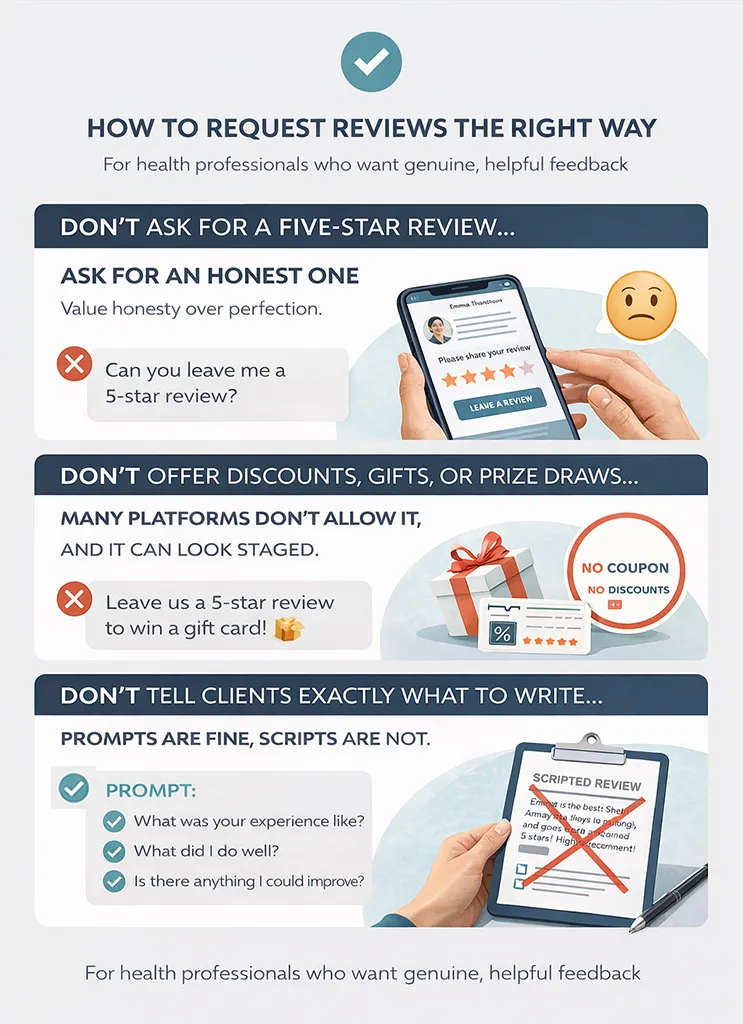
Firm no’s: a few things to avoid
Keep these boundaries clear:
Create a routine that sticks (without pestering anyone)
Consistency beats intensity here. You want a system you can repeat, not a big one-off push.
Build the habit and track your asks
Decide two things:
When you’ll ask (your chosen milestone moments).
How you’ll ask (in person, follow-up message, or both).
Then add a simple tracking method so you don’t ask the same person every visit. If you see clients every four or five weeks, it’s easy to forget you already asked last time.
Your tracking can be low-tech:
This protects the relationship. Nobody wants to feel like they’re being chased.
Give hesitant clients an easy exit
If someone hesitates, give them a clean way out. Something like, “All good, no pressure.”
You can also offer a private option: “If you’d rather share feedback privately, you can email me.” If they do send a lovely email, you can ask if they’d mind you sharing it as a testimonial (with names removed if needed).
Hesitation often means they don’t know how to leave a review or what’s appropriate to say. That’s something you can address gently in your FAQs or in a short blog post clients can refer to later.
Respond to every review (and keep privacy front and center)
Replying to reviews shows you’re paying attention. It also signals warmth to the next person reading.
Keep replies short and privacy-safe. Don’t mention what someone came in for, even if they mention it first. A simple template works well:
“Thanks for your kind words. I’m glad you had a good experience.”
That’s enough. You’re acknowledging their time and keeping their personal details protected.
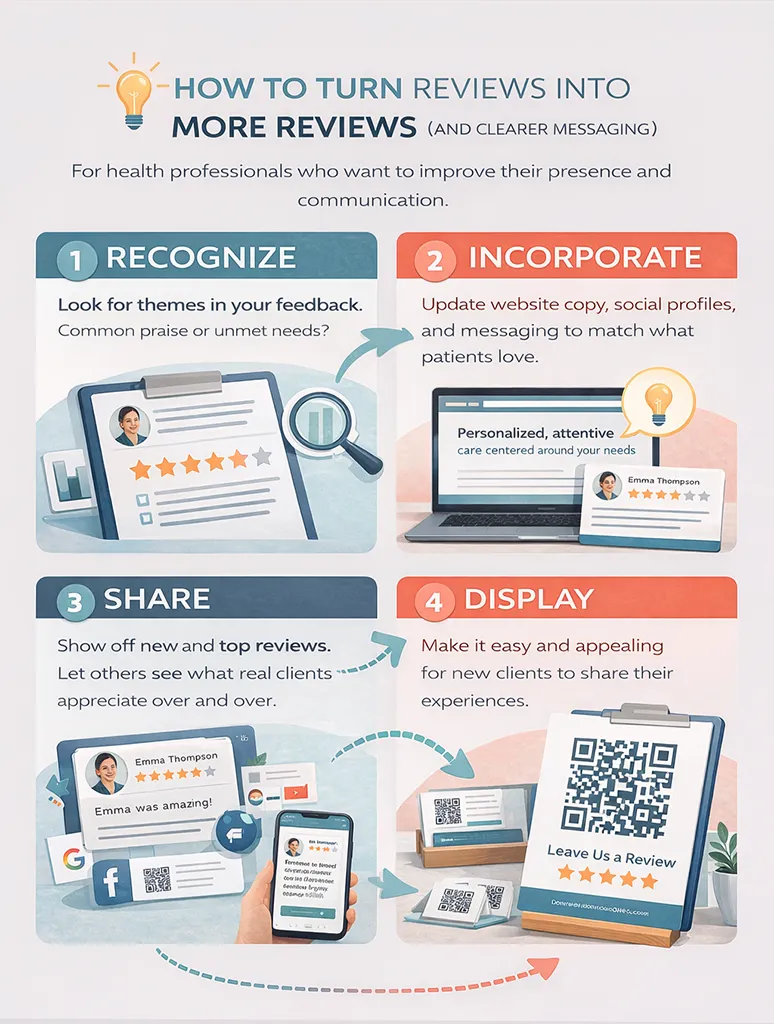
Turn reviews into more reviews (and clearer messaging)
Once reviews start coming in, you can use them in ways that make future reviews easier.
You can add reviews to your website, for example on a testimonials page, or even sprinkled into an FAQ. When clients see examples of “normal” reviews, they feel more confident about writing their own.
You can also share one review at a time on social media. If privacy is a concern (and it often is), you can hide names or remove identifying details.
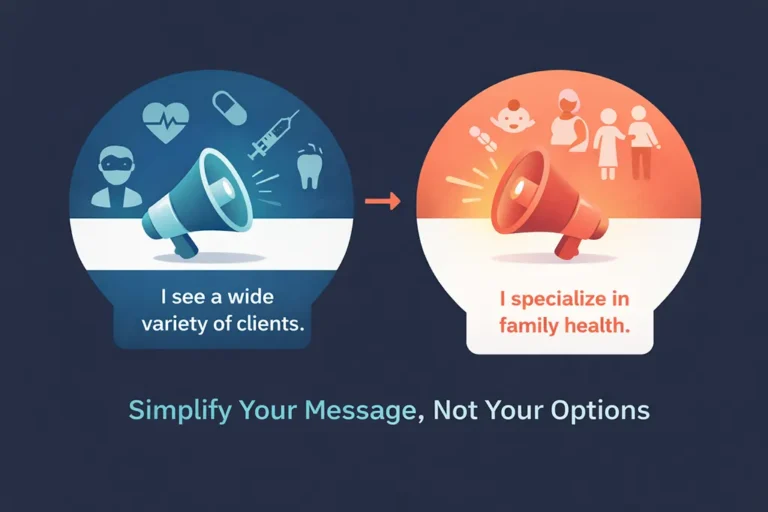
Reviews also help you understand how clients describe your work. Pay attention to repeated phrases. If several clients say they felt “listened to” or “calmer after the first session”, those are words you can mirror on your homepage and in your blog posts. Keep the tone natural, and avoid heavy editing. Real language is the point.
Common mistakes that stall your review flow
A review routine can fail for predictable reasons. Here are the big ones to watch for:
Your 30-day plan to get reviews coming in steadily
You don’t need a fancy campaign. You need a month of calm consistency.
Next steps: keep it simple, keep it honest
When reviews feel awkward, the temptation is to avoid the whole thing. The better option is to build a small routine you can repeat, using a clear ask, a working link, and honest language. Start with the clients who already get value from your care, keep everything low-pressure, and let consistency do the heavy lifting. After 30 days, you’ll have enough results to tweak your timing or your wording, without second guessing every step.
Please Share
Have you got a question that I haven’t answered here? Drop it in the comments. This space is for sharing, not just reading. Sometimes the best advice comes from those who’ve been in the same shoes.
Let’s build a supportive community where no one has to figure it all out alone. And if this helped you today, consider passing it on to a colleague who might need it – a little support goes a long way.
Please pin one of these images to your main business tips board